


“Low-field MRI can fundamentally shift the economics and logistics of imaging.”
— Evan Kervella, CEO of Chipiron
Welcome to Radiology Access! Your biweekly newsletter on the people, research, and technology transforming global imaging access.
In this issue, we cover:
Chipiron Exits Stealth, Targets Breast Cancer Screening with Low-Field MRI
Beyond Anatomy: Teaching Models to See Disease
We Can Debate, But It’s Already Too Late: Private Companies are Already Scaling Whole-Body MRI
Resource Highlight: FREE Courses on MRI Safety in LMICs
If you want to stay up-to-date with the latest in Radiology and AI, then don't forget to subscribe!
Chipiron Exits Stealth, Targets Breast Cancer Screening with Low-Field MRI
Can they translate feasibility into reality?

“Mammography is the standard of care for the problem it is worst at solving.” That’s how Evan Kervella, CEO of Chipiron, frames the challenge of breast cancer screening. In patients with dense breast tissue, tumors can be effectively invisible with up to half of cancers potentially missed. In a recent edition of Radiology Access, we highlighted work from Matthew Rosen’s group at MGH showing that low-field MRI screening is technically feasible. Now, Chipiron is aiming to bring that concept into the clinic with an ultra-low-field, portable MRI system designed for breast screening.
Their timing is deliberate. “Breast MRI is currently the strongest entry point for low-field MRI,” Kervella explained, pointing to surging demand driven by dense breast legislation and a shift toward accessibility and throughput over peak image quality. Chipiron’s approach focuses on improving signal at the source: “Rather than relying solely on higher field strength, we improve signal fidelity at the acquisition level,” using cryogenic noise reduction and system-level engineering, paired with denoising and reconstruction methods tailored for breast MRI.
If successful, this could fundamentally reshape the economics of screening. MRI offers higher sensitivity than mammography and avoids ionizing radiation, but has remained limited by cost and infrastructure. By dramatically lowering those barriers, MRI could move beyond major hospitals and become far more widely accessible. Chipiron’s bet is that making MRI available at scale will matter more than making it picture perfect.
Bottom line: Chipiron is out of stealth mode and have announced they’re targeting breast cancer screening as their first indication.
Beyond Anatomy: Teaching Models to See Disease
Why models must understand pathology, not just anatomy, and how synthetic data can make that possible

Most tissue segmentation models perform beautifully, until you show them a real patient. The moment pathology enters the image, performance starts to break down. A new paper in Radiology: Imaging Cancer takes direct aim at this gap. The algorithm, TumorSynth, comes from the same MGH group behind SynthSeg and is now available in FreeSurfer. SynthSeg was truly a breakthrough: by training on synthetic data, it broke free from the constraint of 3D 1 mm T1-weighted imaging and enabled sequence and resolution agnostic brain segmentation. For the first time, a single model could generalize across the messy heterogeneity of real world clinical scans. With TumorSynth the team takes the next step, building a model that can simultaneously segment normal tissue and tumors.
Like SynthSeg, TumorSynth departs from the traditional supervised training. Rather than relying on a large labeled dataset, it uses a generative framework to synthesize unlimited training examples, pairing heterogenous images with perfectly known labels. TumorSynth has three main components:
Synthetic data generator: A Gaussian mixture model that randomly assigns imaging attributes (e.g., contrast, resolution) during dataset generation.
Tissue and whole tumor segmentation: A primary network that jointly segments normal anatomy and the full tumor volume.
Tumor subsegmentation: A cascaded secondary network that further partitions the tumor into enhancing, non-enhancing, and necrotic regions.
The result is a highly generalizable system that performs well across heterogeneous datasets. TumorSynth achieved Dice scores of 0.89 for both tissue and tumor segmentation, while maintaining a relatively low 4% false-positive rate.
Pathology-aware segmentation could enable more reliable quantitative imaging in real-world settings, where healthy and abnormal cases are intermingled. However for this approach to become more broadly applicable, two challenges stand out:
Maintaining a low false-positive rate.
Expanding beyond tumors to a broader spectrum of pathologies.
If those hurdles can be cleared, this work could point toward a shift in how we think about segmentation, from models that tolerate disease to models that are explicitly designed to understand it.
Bottom line: TumorSynth shows that a single model can handle both pathology and normal anatomy, and it’s available now through FreeSurfer.
We Can Debate, But It’s Already Too Late
While academia debates the evidence, private companies are already scaling whole-body MRI screening
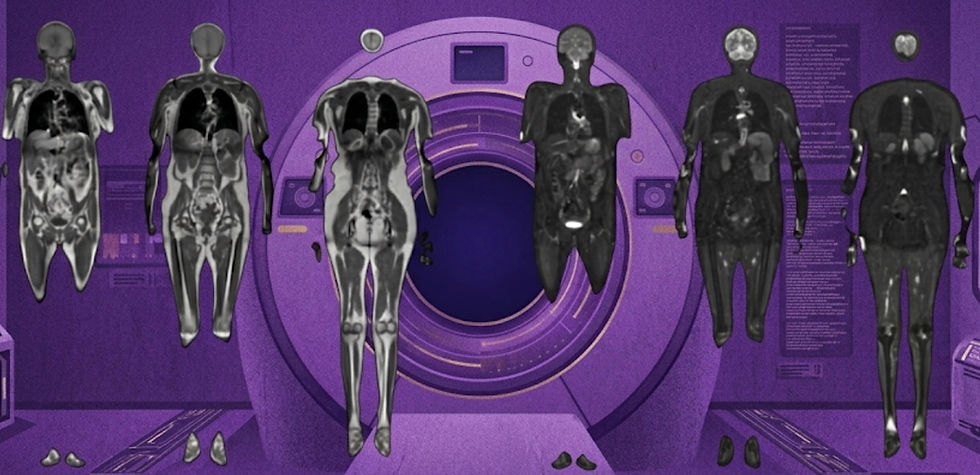
A new systematic review and meta-analysis in European Radiology takes a hard look at whole-body MRI for cancer screening in asymptomatic individuals. Across more than 9,000 patients, the confirmed cancer detection rate was 1.57%. The paper has already sparked debate, both on social media and in letters to the editor, around whether whole-body screening is justified.
Taking a step back, most would agree on a key limitation. These studies are simply not designed to answer questions that matter most. They focus on detection rates, without addressing downstream outcomes like overall survival and cost-effectiveness. The studies needed to provide that level of evidence are longer and more expensive than detection rate studies.
To me, this paper raises a different and perhaps more uncomfortable question: how much does the academic debate even matter anymore?
While researchers argue over evidence thresholds in papers and conferences, companies like Prenuvo are partnering with American Express to offer $450 credit card reimbursements for scans. Prenuvo has completed over 170,000 scans, and raised $120M last year. Meanwhile, rival Function Health (which acquired Ezra) reports hundreds of thousands of members and raised nearly $300M at a $2.5B valuation. The reality is that, regardless of what’s published in academic journals, patients are already getting these scans.
Data from these companies is beginning to emerge. In a preliminary study of 1,011 asymptomatic individuals presented at the American Association for Cancer Research, Prenuvo reported a 2.2% cancer detection rate. They also announced the launch of their Hercules study, targeting enrollment of over 100,000 participants. In the near future it will be these private companies that will have the scale, funding, and longitudinal data to determine whether this approach is clinically valuable and economically viable.
One promising area for academia to hone its focus is opportunistic screening, which can extract additional value from the vast number of scans already being acquired for clinical care. This can allow us to identify findings like aortic calcification or osteoporosis with a dedicated scan, and plays to the strengths of clinical imaging.
For now, the field may be in a holding pattern. The evidence for whole-body screening remains incomplete, however experiments are already underway at a scale academia would struggle to match. The question is no longer whether this trend will continue, but what level of evidence these companies will ultimately be able to produce.
Bottom line: Given the scale and resources of private whole-body companies, the academic debate may be a moot point.
Resource Highlight: FREE Courses on MRI Safety in Low- and Middle-Income Settings

Looking to strengthen MRI safety knowledge, especially in low- and middle-income settings? This FREE course series hosted by ISMRM, ISMRT, and Rad-Aid offers six expert-led sessions, each paired with live Q&A discussions for practical insights. The course is hosted by Emre Kopanoglu (Cardiff University), Michael Steckner (MKS Consulting), Michael Hoff (UCSF), and Pradnya Mhatre (Emory). No worries if you missed a session, you can register here and watch prior videos as well! This is a great opportunity to build real-world expertise and support safer imaging worldwide.
Feedback
We’re eager to hear your thoughts as we continue to refine and improve RadAccess. Is there an article you expected to see but didn’t? Have suggestions for making the newsletter even better? Let us know! Reach out via email, LinkedIn, or X—we’d love to hear from you.
References
Shen, Sheng, et al. "Breast imaging with ultra-low field MRI." Scientific Reports 16.1 (2026): 4518.
Wu, Jiaming, et al. "TumorSynth: Integrated Brain Tumor and Tissue Segmentation on Brain MRI Scans of Any Resolution and Contrast." Radiology: Imaging Cancer 8.2 (2026): e250222.
Martins da Fonseca, João, et al. "Whole-body MRI for opportunistic cancer detection in asymptomatic individuals: a systematic review and meta-analysis." European radiology (2025): 1-11.
Pace, Mario, et al. "Usefulness and clinical impact of whole-body MRI in detecting autoimmune neuromuscular disorders." Brain Sciences 13.10 (2023): 1500.
https://www.functionhealth.com/article/function-announcement
Disclaimer: There are no paid sponsors of this content. The opinions expressed are solely those of the newsletter authors, and do not necessarily reflect those of referenced works or companies.


